Volatility-controlled indexes in fixed indexed annuities exist to solve one problem: option sellers systematically price in more volatility than markets actually deliver, and policyholders absorb that gap as a lower participation rate. Because a volatility-controlled index adjusts exposure to real conditions rather than year-ahead forecasts, effective participation rates can rise when volatility falls.
What is volatility control in a fixed indexed annuity?
A fixed indexed annuity (FIA) earns interest when a market index goes up, while protecting your client's principal from market losses. How much of that gain your client earns depends on the participation rate, set at the start of the crediting period based on how volatile the market is expected to be. This forward looking expectation often overestimates what occurs. Volatility control is designed to adjust to what really happens instead of relying only on that early guess.
How does a fixed indexed annuity earn interest?
With a FIA, your client’s money isn't invested directly in the stock market. Instead, the interest they earn is linked to how a market index, like the S&P 500®, performs. The participation rate decides how much of the index's gain counts toward that interest.
For example: if the index goes up 10% and the participation rate is 50%, the interest credited would be 5%.
What determines FIA participation rates?
To offer index-linked interest payments, insurance companies typically buy options linked to the index(es). The budget for these options is fixed in each period, so a lower option cost means higher participation rates and vice versa. When the market is expected to be more volatile, the options cost more, so the same budget buys less participation.
Bumpier market expected → higher costs → lower participation rate
The problem: the market’s forecast is often too high
Your client's rate is set at the start of the crediting period, before anyone knows how the market will really behave. So it's based on a forecast, and that forecast often turns out to be too cautious. Research published in The Journal of Derivatives in 2024 found that the market's expected volatility for the S&P 500®, implied by options prices, was consistently higher than what actually happened.1
Delaware Life’s own analysis of volatility control in FIAs found something else worth noting: many of the market's best performing years came when conditions were calmer than expected. In those years, a non-volatility controlled strategy’s participation rate was set based on more market turbulence than actually occurred, leaving upside on the table just when it mattered most.
How volatility-controlled indexes adjust participation rates
A volatility-controlled index adjusts to how the market actually behaves:
When the market is calmer than expected, it increases its market exposure. That can raise your client’s effective participation rate.
When the market is bumpier than expected, it reduces its market exposure. That can lower your client’s effective participation rate.
You don't have to bet on the forecast for a whole year. The strategy adjusts as the market moves.
Can volatility control increase interest in a rising market?
Yes, it can, especially when the market is calmer than expected. Here's a hypothetical example using the Nasdaq-100 index in 2023, with a 12% volatility target:
As the market calmed down, the strategy's effective participation rate more than doubled compared to a standard, non-volatility controlled Nasdaq-100 strategy.
By year-end, that would have meant nearly 2% more interest.
This was in a year when the Nasdaq-100 index rose 53.8%, so volatility-control did not dampen the upside.
Volatility control doesn’t have to mean giving up growth
Participation Rate Adjusted Index Payoffs
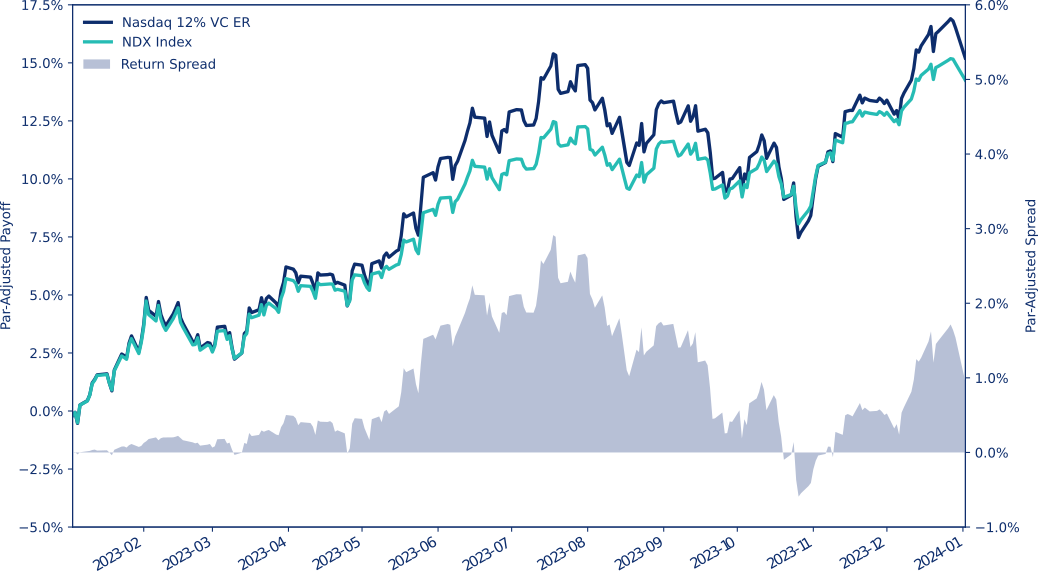
Source: Bloomberg data and Delaware Life analysis. 12/31/2022 – 12/31/2023
This is a hypothetical example for illustration only. It doesn't represent any specific product. Past performance doesn't guarantee future results.
Why have some volatility-controlled strategies underperformed?
Some volatility-controlled strategies haven't lived up to expectations. In our view, that's mainly because:
Large U.S. stocks have had an unusually strong, steady run in recent years.
Other features in some strategies held them back, not the volatility control itself.
Is a volatility-controlled FIA strategy right for your client?
Volatility control was built to fix a real problem: when the market overestimates volatility, your client’s interest can end up lower than it could have been. By adjusting to how the market actually behaves over the crediting period, these strategies may help your client get more out of their annuity over time.
It isn't the right fit for everyone. Talk with your client about whether a volatility-controlled strategy fits their goals.
FAQs: Volatility control and fixed indexed annuities
Can my client lose money if the market drops?
No. Your client's principal is protected from market losses. Fees and surrender charges may apply if your client withdraws early, and guarantees depend on the financial strength of the insurance company.
What's a participation rate?
It's the share of an index's gain used to calculate the interest your client earns.
What does "volatility" mean?
Volatility is a statistical measure of how much and how quickly the market moves up and down.
Will volatility control limit my client's growth?
Not necessarily. Volatility control can increase market exposure when the market is calm. When the market is bumpy, it reduces exposure, which can mean less interest.
Is my client investing in the stock market?
No. A FIA is an insurance product. It isn't a security and doesn't invest directly in the stock market or any index.
Sources
1 Bloomberg data and Delaware Life analysis. Reference: Umarov, J., Lütkebohmert, E., & Halbleib, R. (2024). Exploiting the Gap Between Implied and Realized Volatility. The Journal of Derivatives, 12–42.