PLANNING FOR A RETIREMENT THAT LASTS
LONGEVITY RISK:

Longevity risk is an increasingly important consideration in retirement planning. As life expectancy climbs and traditional retirement milestones shift, advisors are on the front line of helping clients rethink how long their money needs to last. With the right strategies, you can turn an uncertain risk into lasting confidence for your clients.
Key Takeaways
Longevity risk is the possibility of outliving retirement savings.
Even modest inflation amplifies the risk, and for clients who live longer, inflation risk compounds.
Different client profiles (couples, singles, widowers) face unique longevity risks and need customized approaches.
Conversation starters are helpful to unlock deeper client engagement around retirement fears and goals.
Guaranteed income solutions and flexible planning strategies can protect clients and provide lasting confidence.
WHAT IS LONGEVTIY RISK?
Longevity risk is the possibility that a client will outlive their retirement savings. Thanks to medical advances and healthier lifestyles, people are living longer. Further, not all retirements are planned. Company downsizing or caring for loved ones could push some people into retirement on a different timeline than they anticipated. For advisors, that means creating plans that stretch assets over more years than past generations ever had to consider.
The challenge with longevity risk is that it’s uncertain: no client knows how long they will live, but most underestimate their lifespan. That uncertainty makes it difficult to gauge whether their retirement savings and income strategies will last longer than their life expectancy. Advisors are in a unique position to turn that unknown into a structured financial plan.
Longevity Risk vs. Mortality Risk
These two risks are often mentioned together, but they carry very different implications for retirement planning:
Longevity risk = Outliving retirement assets.
Mortality risk = Passing away earlier than expected.
Both shape retirement planning and should be discussed with clients, but longevity risk puts the focus on sustaining retirement income for life, not just leaving a legacy. In practice, longevity risk often feels more immediate because clients ask, “Will I outlive my money?” Mortality risk, meanwhile, drives concerns like, “What happens to my spouse if I pass away first?” A thoughtful retirement plan addresses both sides but emphasizes income sustainability so clients feel financially secure whether they live 10 years in retirement or 40.
Mortality risk is about protecting loved ones if you pass away too soon. Longevity risk is about protecting yourself if you live longer than expected. Both matter, but they call for different strategies.
Longevity Risk
The risk of outliving retirement savings.
Clients worry: "Will I run out of money if I live longer than expected?"
Focus: Sustaining income for life.
Mortality Risk
The risk of passing away earlier than expected.
Clients worry: "What happens to my spouse or family if I die too soon?"
Focus: Protecting loved ones and providing survivor benefits.
Longevity Risk and Inflation
Longevity risk doesn’t exist in a vacuum; there are other market factors that have a big impact over time, like inflation. Even modest inflation steadily erodes purchasing power over a 20- to 30-year retirement, making today’s income feel inadequate tomorrow. For clients who live longer, this risk compounds, and expenses like healthcare and everyday living may rise faster than expected. Advisors can address both risks together by building strategies that provide not only guaranteed lifetime income, but also growth potential to help offset inflation over time.
Example: Near-Retiree Facing Longevity Risk and Inflation
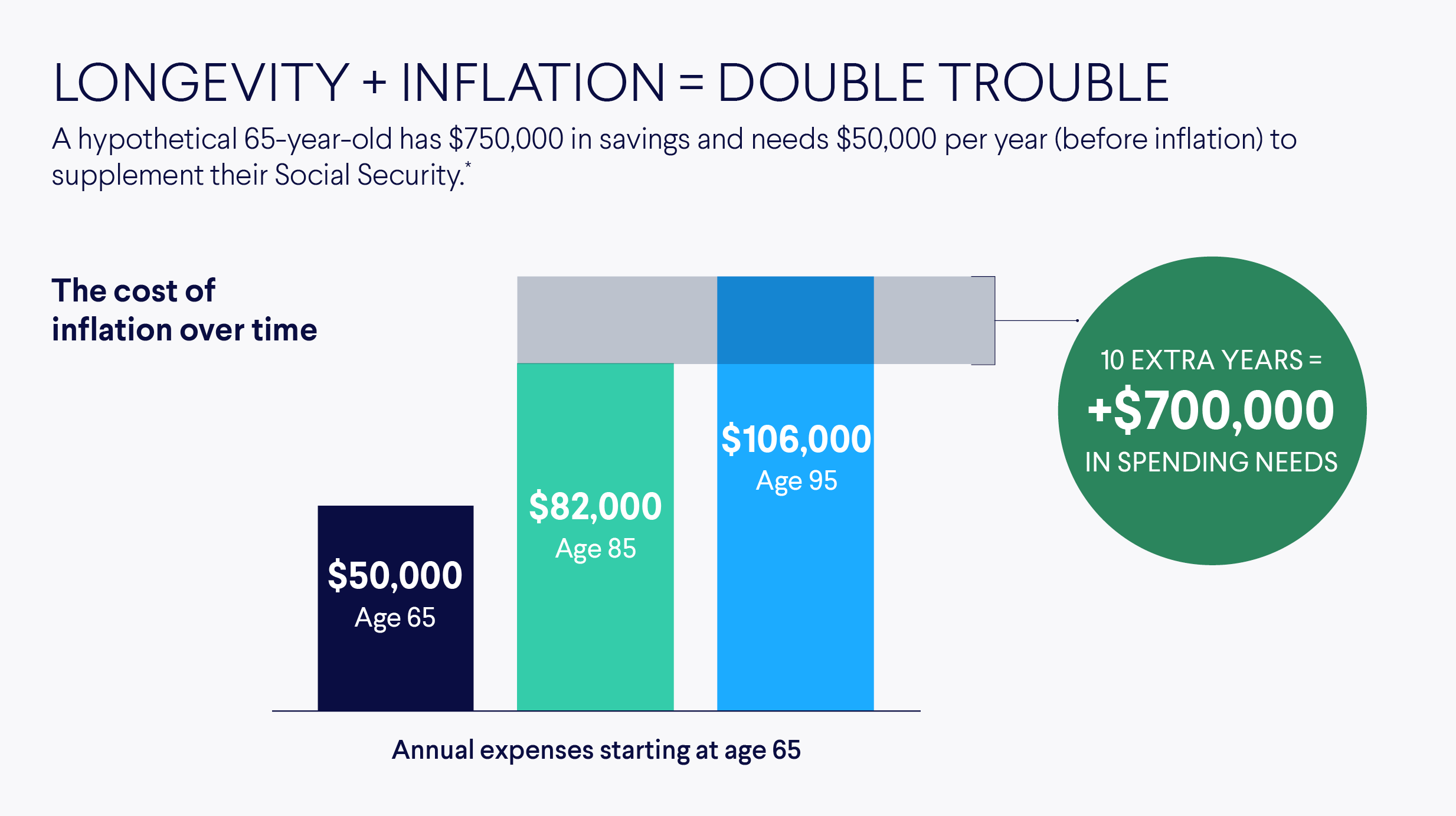
A 65-year-old client has $750,000 in savings and needs $50,000 per year (before inflation) to supplement their Social Security. (Note that in this example, we are not adjusting year over year earnings for cost of living, but Social Security benefits are reevaluated for inflation yearly.)
If they live 20 years (to age 85): With 2.5% inflation, annual expenses grow to about $82,000 by year 20. Over two decades, they’ll need roughly $1.2 million total.
If they live 30 years (to age 95): Annual expenses grow to nearly $106,000 by year 30. Over three decades, total withdrawals climb to about $1.9 million, more than double their original savings.
The difference between 20 and 30 years in retirement isn’t just 10 extra years; it’s an additional $700,000 in spending needs driven largely by inflation. This makes guaranteed income solutions and growth strategies essential to protecting clients who live longer.
WHY LONGEVITY RISK MATTERS FOR YOUR CLIENTS
Couples: Longer combined life expectancy means one partner is likely to live much longer than the other, requiring income continuity for the survivor.
Singles: No partner’s benefits to rely on; financial independence must be sustained.
Widowers: Sudden loss of a spouse often means reduced Social Security benefits and possible lifestyle adjustments.
Nearing retirement: Urgent need to align savings, income products, and retirement date. Unlike current retirees, most workers approaching retirement don’t believe they’ll have enough guaranteed lifetime income—such as Social Security, pensions, or annuities—to cover their basic living expenses. In fact, only 48% of non-retirees surveyed in 2024 by LIMRA expect these sources to fully meet their essential needs without tapping into personal savings.
Living in retirement: Focus shifts to efficient withdrawal strategies and protecting assets against market volatility.
Longevity Trends to Know
Life expectancy is rising
Average U.S. life expectancy is climbing, up to 79.40 years old in 2025 (vs. 2005 average of 77.49 years.)*
Retirement often comes sooner
More clients are retiring on a different timeline than expected—a 2024 LIMRA study found that 47% of retired investors did not retire when originally planned.1
Savings must stretch further
That makes longevity risk even more pressing: the earlier retirement begins, the longer those savings need to last. Advisors can prepare clients by prioritizing flexible strategies that include guaranteed income and accumulation potential.2
LONGEVITY RISK PLANNING MATRIX
Tailor the conversation by client segment
Understanding the unique concerns and financial situations of different client segments is crucial in effectively managing longevity risk. Each segment faces distinct challenges and opportunities that require customized strategies to ensure financial security throughout retirement
We’ve outlined some key client profiles, questions, and ideas for more focused planning sessions.
Often, advisors stop at asking clients, “What are your greatest concerns?” Drill deeper. A stronger conversation asks, “What do you want to do for your family? And what do you need to do for yourself?” That’s where real clarity comes in.
| Client Profile | Key Longevity Risk Questions | Suggested Planning | Questions for Clients Nearing Retirement | Questions for Clients Living in Retirement |
|---|---|---|---|---|
| Couples | “What happens if one of us lives significantly longer than the other?” | Joint income options, survivor benefits, fixed index annuities (FIAs) with income riders | “Does your retirement plan have the flexibility to adapt if one of you has to stop working earlier than expected?” | “If one spouse passed away today, would the survivor have enough guaranteed income to maintain your lifestyle?” |
| Singles | “How can I make sure my money lasts?” | Guaranteed lifetime income streams, flexible withdrawal strategies | “Does your retirement plan have the flexibility to adapt if you have to stop working earlier than expected?” | “How comfortable are you with the possibility of needing to reduce spending later in retirement?” |
| Widowers | “How do I replace lost income after my spouse’s passing?” | Income annuities, Social Security optimization | “Does your plan have the power to make up for the lost retirement income after your spouse’s passing?” | “If your expenses rise with age, how will you cover the shortfall without your spouse’s income?” |
Keep in mind, many clients don’t get to choose when retirement starts; it may come earlier than planned. That’s why flexibility and guaranteed income can be crucial components of longevity risk conversations.
CONVERSATION STARTERS
Use these prompts to open deeper discussions with clients about longevity risk:
“If you live to 95, what would you like your lifestyle to look like?”
“Would you feel more confident knowing part of your income is guaranteed for life?”
“How important is leaving a legacy compared to maintaining your income in retirement?”
“How would your retirement plan change if you had to stop working earlier than expected, and lived much longer than planned?”
STRATEGIES FOR FINANCIAL LONGEVITY PLANNING
Guaranteed income they can’t outlive. FIAs, MYGAs, and income annuities can provide predictable lifetime income that market fluctuations can’t erode.
Plan for the unexpected. Retirement is a multidecade stage of life that may start earlier and last longer than clients anticipate. Build in guaranteed income and revisit plans every 3–5 years to stay ahead of changes in health, markets, and lifestyle
BOTTOM LINE
Longevity risk is a challenge, but also a chance to show real value by helping clients build a plan that works, even if retirement starts early and lasts decades.
And don’t forget – we’re here to help! Reach out to your local wholesaler or visit AdvisorNext for more resources and information.
* Source: Macrotrends.net, https://www.macrotrends.net/global-metrics/countries/usa/united-states/life-expectancy, accessed 9/4/2025.
1 Drinkwater, Matthew, Ph.D., FSRI, FLMI, AFSI, PCS and LIMRA LOMA. 2024 Retirement Investors: Behaviors, Attitudes, and Financial Situations, p. 7, LIMRA.com.
2 Ibid., p. 32.