Helping clients stay steady when markets get bumpy
VOLATILITY RISK AND RETIREMENT PLANNING

When markets swing, emotions follow. And for clients in or near retirement, that emotional response can trigger financial decisions with long-term consequences. Understanding each client’s risk tolerance is essential for making sound retirement decisions during volatile periods.
Key Topics
What is Volatility Risk?
The Real Retirement Risk: Sequence of Returns
Volatility and the Other L.I.V.E. Risks
Framing the Conversation: From Fear to Focus
Sample Retirement Scenarios
Annuities: Protected Growth Against Volatility
Communication in Volatile Times
Coaching Through Volatility
WHAT IS VOLATILITY RISK?
Volatility risk refers to the potential impact of unpredictable market fluctuations on a client’s retirement portfolio. Unlike inflation or longevity risk, which tend to follow longer-term trends, volatility can be sudden, emotional, and often amplified by media headlines. The risk is not just about what the markets do; it’s about how clients react.
Volatility can erode client confidence, prompt impulsive decisions, and most importantly, undermine key pillars of retirement security: predictable income, long-term growth, and asset longevity.
“Volatility is the absence of predictability. It doesn’t just shake confidence—it kicks out the legs of a retirement plan: income, growth, and longevity.”
– Matt McGinley, Divisional Sales Manager, West Coast Division Delaware Life
THE REAL RETIREMENT RISK: SEQUENCE OF RETURNS
Volatility becomes especially dangerous in the form of sequence of returns risk, which is the risk that negative returns early in retirement, combined with withdrawals, will drain savings faster. Even portfolios with the same average return can deliver dramatically different outcomes depending on the order in which gains and losses occur.
When clients retire can matter as much as how much they’ve saved.
Consider two retirees with identical portfolios, withdrawal strategies, and average returns. The only difference? One retires into a bull market, the other into a bear market
Retiree A starts retirement during a strong market and sees early growth. Their portfolio has time to compound before any downturns hit, so withdrawals have less impact.
Retiree B starts during a down market. Early losses combined with regular withdrawals lock in those losses and reduce the portfolio’s ability to recover—even if long-term market performance improves.
Retiree B, who faced early downturns, depleted their savings far sooner than Retiree A, despite both portfolios having the same long-term average return.
| SCENARIO | RETIREE A (UPMARKET START) | RETIREE B (DOWNMARKET START) |
|---|---|---|
| Starting Balance | $500,000 | $500,000 |
| Annual Withdrawal | $25,000 | $25,000 |
| Market Sequence | Strong gains early, losses later | Early losses, gains later |
| Average Return | 7.33% | 7.33% |
| Portfolio Outcome | Balance remains after 25 years | Account depleted in year 19 |
| Key Risk | Minimal | Sequence of returns risk |
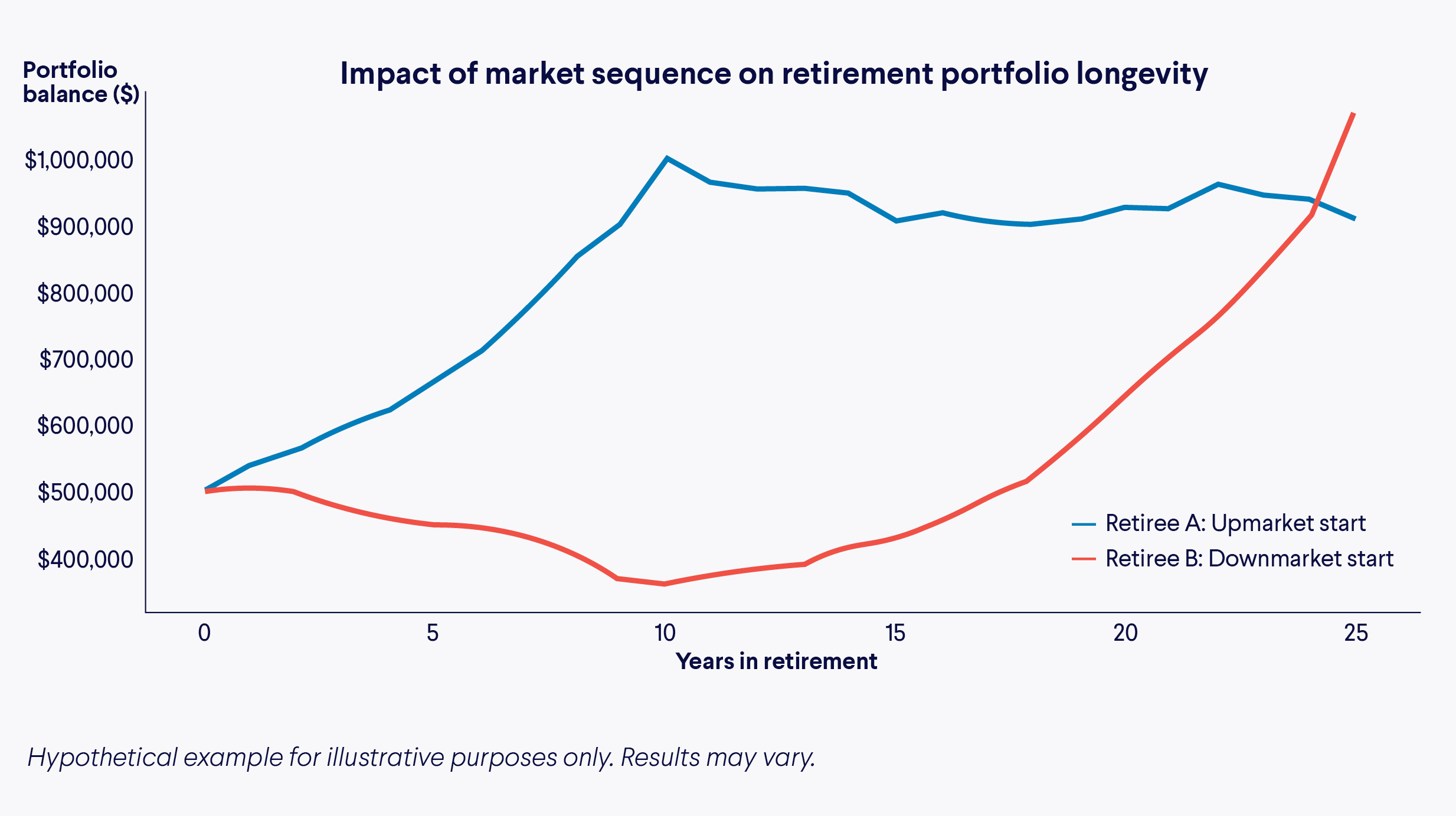
The takeaway? The sequence, not just the average return, matters. And volatility amplifies this risk. To illustrate this risk for your clients, use our Retirement Roulette chart.
Advisors can add real value by building in safeguards that make market timing less critical to long-term outcomes.
When clients retire can matter as much as how much they’ve saved.
VOLATILITY AND THE OTHER L.I.V.E. RISKS
Volatility rarely acts alone. It connects to every other retirement risk and is often amplified by multiple risk factors:
Longevity Risk
The longer clients live, the more downturns (and upmarkets) they’ll face.
Inflation Risk
Rising costs amplify the strain of market losses.
Emotion Risk
Fear and euphoria often drive clients to act at the worst possible times.
Understanding how these risks interact helps advisors frame volatility as part of the bigger picture — not just another market story. The goal isn’t to avoid volatility. It’s to build a plan that keeps income intact while markets work through their cycles.
FRAMING THE CONVERSATION: FROM FEAR TO FOCUS
The advisor’s role is to reframe market noise into long-term strategy. McGinley puts it simply: “A good advisor doesn’t have all the answers—they ask questions. They help the client get to the root of why they’re feeling uneasy, so the solution is tailored, not reactive.”
“Customers don’t buy products. They buy outcomes. Our job is to help advisors keep the focus on where the client is going—not the bumps in the road along the way.”
– Matt McGinley
SAMPLE RETIREMENT SCENARIOS
Volatility doesn’t have to derail client progress or goals. Creating the right mix of protected income and long-term growth opportunities can be the difference between a solid plan and locked in losses for life. Review the two contrasting scenarios to see just how much planning for volatility can save:
Scenario 1: Retiring Right Before a Downturn
A client retires with $1 million, but the market drops 20% in the first year. Without a source of guaranteed income, withdrawals lock in those losses, dramatically reducing the portfolio’s longterm sustainability.
“Most clients have a financial plan or an estate plan—but what they really need is a clear income strategy: how and when they’ll take distributions in retirement. There are multiple approaches— systematic withdrawals, bucket strategies, annuities—but the key is to lay it out in advance.”
– Anders Smith, CFP®, CIMA®, CPWA®, RMA®, RICP®, Vice President, Managing Director – National Sales Consulting
Scenario 2: Retiring With a Plan for Volatility
A client enters retirement with $1 million and a written income strategy that segments their assets into three buckets:
$300,000 in a fixed index annuity to provide guaranteed lifetime income
$200,000 in a cash reserve and short-term bond ladder to cover 5–7 years of essential expenses
$500,000 in a diversified equity portfolio for long-term growth
In year one, the market drops 20%. Instead of drawing from the equity portfolio, the client relies on income from the annuity and short-term reserves. By avoiding withdrawals during the downturn, their growth assets remain intact and recover as the market rebounds over the next few years.
With a formal income plan, short-term volatility doesn’t threaten long-term outcomes, and the client stays on track without needing to make emotional decisions.
ANNUITIES: PROTECTED GROWTH AGAINST VOLATILITY
Variable and fixed index annuities can both play a role in providing guaranteed retirement income that protects against market volatility. One of the most effective tools for reducing volatility risk is a fixed index annuity (FIA). FIAs can
Provide protected growth with 0% downside risk
Lock in annual gains to preserve performance over time
Deliver guaranteed lifetime income regardless of market conditions
McGinley notes that annuities are often misunderstood: “Advisors miss the efficiency annuities bring to a plan. They can generate the same income as a much larger invested portfolio, which frees up other assets for growth or legacy. That’s not just protection. That’s leverage.”
COMMUNICATION IN VOLATILE TIMES
Volatility is as much an emotional challenge as a financial one. The best advisors combine education with empathy, helping clients feel heard while staying grounded in the facts
ASK MORE EFFECTIVE QUESTIONS
Instead of yes/no questions (“Are you worried?”), ask open-ended ones (“How is this volatility affecting your goals?”).
REMIND CLIENTS OF THE PLAN
Show them that volatility was anticipated and planned for.
COMMUNICATE CONSISTENTLY
Regular outreach reassures clients that their advisor is engaged, not reactive.
Strong communication not only protects relationships — it can become a growth driver, as calm clients share their confidence with others. While there’s no one-size-fits-all solution, advisors can combine strategies to protect income and keep clients invested with confidence
COACHING THROUGH VOLATILITY
Volatility will always be part of the market, but it doesn’t have to derail your client conversations.
Consider:
Reframing emotional responses into strategic decisions
Demonstrating the importance of income stability
Highlighting solutions that put the focus back on outcomes, not headlines
“Teach, don’t preach,” McGinley emphasizes. “Clients don’t buy products—they buy outcomes. And when you can deliver a plan that makes volatility irrelevant to their lifestyle? That’s confidence. That’s value.”
AND DON’T FORGET – WE’RE HERE TO HELP!
Reach out to your local wholesaler or IMO support team, or visit our L.I.V.E. hub for more resources and information.