Required minimum distributions (RMDs) are a mandatory feature of tax-deferred retirement accounts — and understanding what your clients owe each year is essential to building a sustainable income plan. Use this calculator to project future RMDs and explore how they fit into the broader retirement income picture. Share the results with clients, use the projections to guide withdrawal sequencing conversations, and connect distribution planning to guaranteed income strategies that can help reduce tax exposure over time.
What Is a Required Minimum Distribution?
A required minimum distribution is the minimum amount the IRS requires account holders to withdraw each year from most tax-deferred retirement accounts once they reach a certain age. Under the SECURE Act 2.0, that age is currently 73. Because contributions to traditional IRAs, 401(k)s, and similar accounts were made on a pre-tax basis, the IRS requires that these funds eventually be withdrawn and taxed as ordinary income. RMDs ensure that tax-deferred savings are not indefinitely sheltered from taxation.
The withdrawal amount required changes each year. It is calculated by dividing the prior year-end account balance by a distribution period figure found in the IRS Uniform Lifetime Table, which is based on life expectancy. Missing or underpaying an RMD can result in a 25% excise tax on the shortfall, though timely correction may reduce the penalty to 10%.
Which Accounts Require RMDs?
RMDs apply to most tax-deferred retirement accounts, including:
Traditional IRAs
Traditional 401(k), 403(b), and 457 plans
SEP IRAs and SIMPLE IRAs
Other qualified pre-tax plans
Roth IRAs are generally not subject to RMDs during the original owner’s lifetime, as contributions are made with after-tax dollars. However, Roth 401(k)s were historically subject to RMDs, though SECURE Act 2.0 eliminated this requirement beginning in 2024. Inherited IRAs — both traditional and Roth — follow separate distribution rules that depend on the beneficiary’s relationship to the original account owner and when the original owner passed away. Financial advisors should consult with a tax professional or refer to IRS guidance when evaluating inherited IRA RMD obligations.
Required Minimum Distribution Calculator
This calculator is for informational purposes only.
Key inputs that affect RMD projections:
Prior year-end balance: RMDs are calculated based on what was in the account on December 31 of the previous year, not the current balance.
Account type: Different plan types may follow slightly different distribution rules. This calculator covers traditional IRAs, 401(k)s, and other qualified pre-tax accounts.
Beneficiary status: If the account owner’s spouse is the sole beneficiary and is more than 10 years younger, the IRS allows use of the Joint Life Expectancy Table, which produces a smaller annual RMD.
Rate of return assumption: A higher assumed rate of return will project growing account balances and correspondingly larger future RMDs.
How to Read Your RMD Results
This calculator projects RMDs based on the prior year-end account balance, the account owner’s age, an assumed rate of return, and the designated beneficiary information. The results represent estimates only and are intended to illustrate how RMDs may grow over time as account balances change.
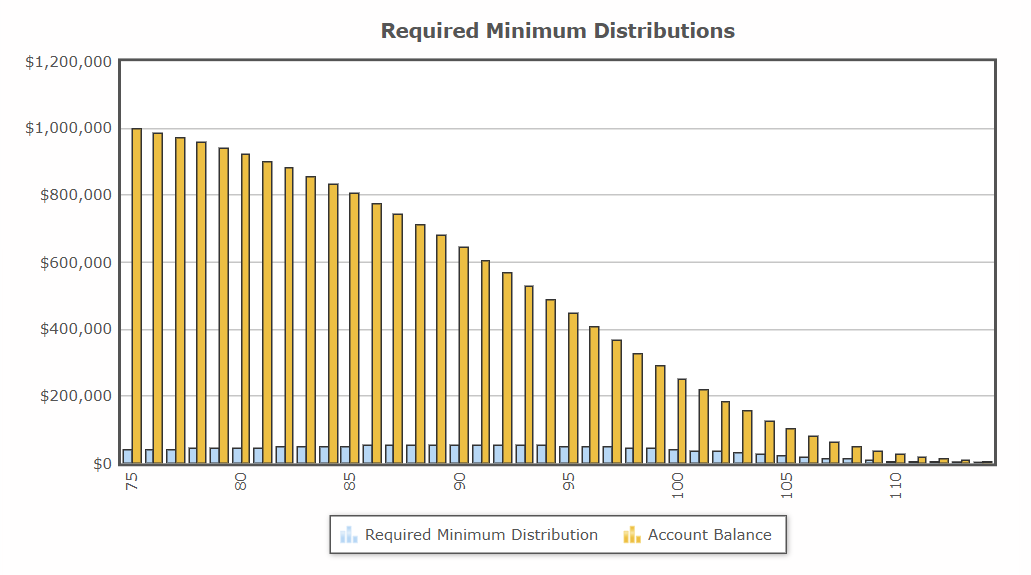
For example, consider a 76-year-old account owner with a traditional IRA balance of $1,000,000 at the end of the prior year, a 3.0% assumed rate of return, and a spouse of the same age as the sole designated beneficiary. Using the IRS Uniform Lifetime Table, the calculator projects a current-year RMD of $42,194.
This hypothetical example is used for illustrative purposes only. Past performance is not indicative of future results.
The accompanying graph and table show how that figure is expected to change year over year — reflecting both the gradual decline in the IRS life expectancy divisor and the effect of ongoing withdrawals on the account balance. As the account balance decreases over time, annual RMD amounts will also begin to decline, even as the percentage of the account that must be withdrawn each year continues to rise.
How to Use This Tool in Client Conversations
The RMD calculator is a practical starting point for retirement income discussions. Here are several ways financial advisors can integrate the results into client conversations:
Run projections together: Walk through the calculator with clients in real time to illustrate how their RMD obligations may grow and what that means for their tax situation.
Introduce withdrawal sequencing: Use projected RMDs to frame a conversation about when to draw from different account types to minimize lifetime taxes.
Connect to income sustainability: Link RMD projections to the client’s overall income plan — especially as it relates to longevity risk and the need for predictable income in later retirement years.
Identify annuity opportunities: When RMD projections reveal significant future distributions from tax-deferred accounts, use that data to introduce the role of guaranteed income products in stabilizing retirement cash flow.
Revisit annually: RMD amounts change each year as account balances fluctuate. Build annual RMD reviews into the planning calendar as a touchpoint for ongoing income planning conversations.
Why RMDs Matter for Retirement Income Planning
For many retirees and near-retirees, RMDs are not just a compliance requirement — they are a significant income event. Understanding projected RMD amounts helps financial advisors:
Anticipate tax liability: RMDs are taxed as ordinary income. Large distributions can push clients into higher tax brackets, trigger Medicare surcharges (IRMAA), or increase the taxability of Social Security benefits.
Plan withdrawal sequencing: Knowing the size and timing of future RMDs helps financial advisors determine the optimal order for drawing down taxable, tax-deferred, and tax-free accounts.
Manage longevity risk: RMDs must be managed alongside longevity risk, which can extend withdrawals across a 20- to 30-year retirement.
Account for inflation: While RMD amounts may grow as account balances increase, inflation can erode the purchasing power of those distributions over time.
Respond to market volatility: Market volatility in the early years of retirement can compound the tax burden of RMDs if account balances fluctuate significantly.
A note on sequence of returns risk: A poorly timed market downturn in the early years of retirement can permanently impair a portfolio's ability to sustain withdrawals. RMDs intensify this risk because they are mandatory regardless of market conditions — potentially forcing retirees to sell assets at depressed prices and reducing the shares available to participate in a eventual recovery. Financial advisors who project RMD obligations in advance can help clients build buffers, such as cash reserves or Roth conversion strategies, that reduce the need to liquidate equities during downturns.
Using RMD Planning to Inform Guaranteed Income Strategies
RMD planning is a natural entry point for conversations about guaranteed income. As required distributions grow over time, clients face increasing exposure to income tax and market risk on their tax-deferred balances. Financial advisors can use projected RMD data to identify opportunities where a reallocation into guaranteed income products may reduce long-term tax burden and improve income predictability.
For clients with substantial tax-deferred balances, a fixed indexed annuity (FIA) can provide guaranteed income that complements or offsets required distributions. Because annuity income can be structured as a predictable, contractually guaranteed stream, it can reduce reliance on portfolio withdrawals and help clients manage the income volatility that comes with fluctuating RMD amounts. FIAs can help clients build a predictable income floor while maintaining tax-deferred growth potential.
This conversation is especially relevant for clients who:
Have large traditional IRA or 401(k) balances approaching RMD age
Are concerned about rising tax exposure as distributions grow
Want to reduce sequence-of-returns risk on their remaining portfolio
Are looking for income sources that can continue regardless of market conditions
RMD FAQs
It depends. If an annuity is held as part of a tax-qualified account, RMDs could apply. Annuities outside those accounts funded by after-tax dollars are typically not subject to RMDs. Financial advisors can guide clients on the best ways to minimize their tax burden as they transition into retirement.
Under the SECURE Act 2.0, the required beginning date for RMDs is April 1 of the year after you turn 73. After that first year, RMDs must be taken by December 31 of each subsequent year. Delaying the first RMD to April 1 means you will take two distributions in that calendar year, which may have tax implications.
Missing an RMD or taking less than the required amount can result in a 25% excise tax on the underpayment. If the shortfall is corrected within two years, the penalty may be reduced to 10% under SECURE Act 2.0 guidelines. Advisors Financial advisors should work with clients to ensure RMDs are taken on time each year to avoid unnecessary penalties.
Yes. Clients can always withdraw more than the RMD amount from their tax-deferred accounts. However, those additional withdrawals will also be subject to ordinary income tax. Excess withdrawals do not carry over to satisfy future RMD requirements. Advisors Financial advisors should weigh the tax implications before recommending larger voluntary distributions.
Generally, no. Roth IRAs are not subject to RMDs during the original owner’s lifetime. However, inherited Roth IRAs may be subject to distribution requirements depending on the beneficiary’s relationship to the original account owner and the year of the original owner’s death. Advisors Financial advisors should review applicable rules with clients who have inherited Roth accounts.
RMD funds cannot be returned to an IRA, 401(k), or other tax-advantaged retirement account. However, once withdrawn, clients may invest the after-tax proceeds into a taxable brokerage account, use them for expenses, or donate them to a qualified charity. Qualified charitable distributions (QCDs) allow clients age 70½ or older to direct up to $105,000 per year (as of 2024) from an IRA directly to a qualifying charity, which counts toward the RMD and excludes the amount from taxable income.
Explore Our Retirement Planning Calculators
RMD planning is one part of a broader retirement income strategy. Use these additional tools to deepen the planning conversation with clients:
Longevity Calculator: Estimate how long a client may need their retirement income to last — an essential input for RMD and withdrawal planning.
Inflation Income Calculator: Explore how rising costs may erode the real value of RMDs and other retirement income sources over a 20- to 30-year period.
Compound Interest Calculator: Help clients identify their investor profile and use that insight to guide decisions about how aggressively to invest remaining tax-deferred assets.