The L.I.V.E. Risk Calculator is a guided conversation tool for advisors and clients to complete together designed to uncover how each client really thinks about longevity, inflation, volatility, and the emotions that drive their financial decisions.
Four Retirement Risks, One Honest Conversation
Standard risk tolerance questionnaires measure how comfortable a client is with market fluctuations. But retirement introduces a different set of challenges — ones that don't fit neatly on a simple conservative-to-aggressive scale. The L.I.V.E. framework addresses four common retirement-specific risks that can quietly undermine even a well-built plan.
L — Longevity Living longer is one of the greatest gifts, but it can also be one of the biggest financial challenges. Your client's retirement income needs to outlive them, plain and simple. The catch? Most people badly misjudge how long that actually is.
I — Inflation Rising costs don't pause in retirement. In fact, the spending categories that matter most to retirees — healthcare, housing, daily essentials — often rise faster than headline inflation. A plan that doesn't grow with costs will gradually lose ground.
V — Volatility Market downturns hit differently in retirement than during accumulation years. When a client is drawing down instead of building up, a poorly timed loss can have consequences that outlast the market's recovery. A major market downturn in the first five years of retirement can increase the chance of running out of money if retirees do not adjust down their spending (Morningstar).
E — Emotion This is the dimension most assessments miss entirely. How a client feels about uncertainty — and how much headlines, market news, or conversations with friends influence their decisions — matters as much as their financial situation. The L.I.V.E. Risk Calculator measures it directly.
The L.I.V.E. Risk Calculator
Use the L.I.V.E. Risk Calculator tool with your client. Each question is designed to show how they think — not just what they know about retirement and financial planning. A strong assessment can also reveal gaps in financial, estate, or tax planning that may affect retirement readiness, including exposure to taxes. Scores calculate automatically across all four pillars, producing a personalized L.I.V.E. Risk Profile you can use to guide the rest of your conversation. It can also help evaluate whether a client’s current savings rate and investment strategy align with retirement goals.
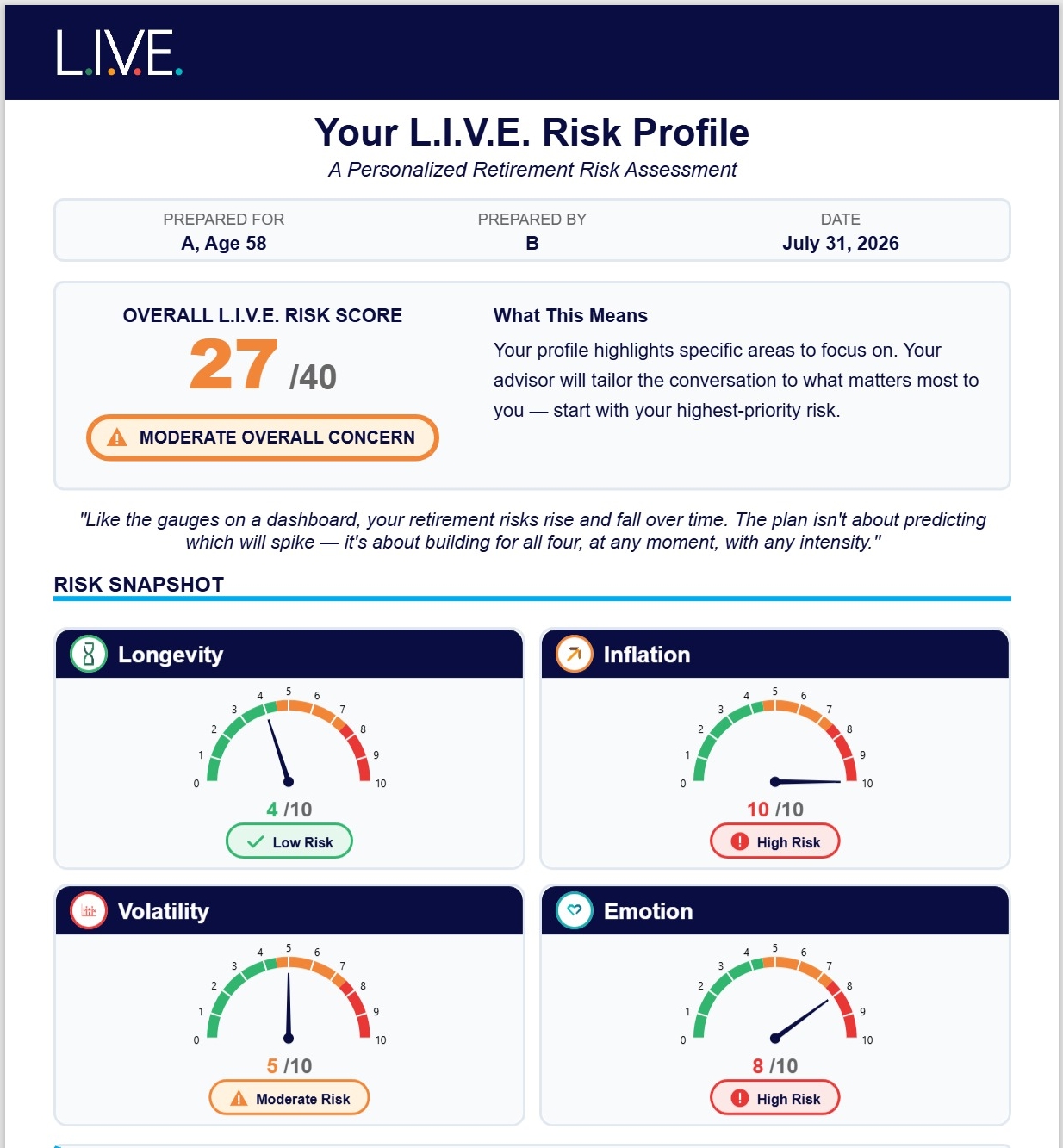
Sample Results:
When you walk through the calculator with your clients, you can expect results like the screenshot below, with recommended explanations and next steps.
Using This Tool In Client Conversations
The L.I.V.E. Risk Calculator was built for use in an advisor-client meeting. Walk through the questions together: the tool will prompt conversation, not just collect answers. Three formats: awareness probe, concern probe, scenario. All built to get the client talking.
Once all questions are answered, the Risk Profile generates automatically, giving you a four-pillar score and personalized insight you can use to structure your next steps. That profile can help guide investment decisions within the client’s overall retirement plan.
Common Questions about Retirement Risk
A risk calculator is a structured tool that helps identify how prepared a client is for the specific challenges of retirement. Unlike general investment risk surveys, a retirement-focused assessment looks beyond market tolerance to address risks such as longevity, inflation, and the sequence of returns. The L.I.V.E. tool is designed specifically for this purpose, and is meant to be completed with a financial advisor in a guided conversation.
Investment risk tolerance typically measures how comfortable someone is with short-term market fluctuations and potential portfolio losses. Retirement risk is broader: it includes the risk of outliving your savings (longevity risk), the erosion of purchasing power over time (inflation risk), the danger of a poorly timed market downturn early in retirement (volatility and sequence of returns risk), and the emotional responses that can lead to costly financial decisions. The L.I.V.E. framework addresses all four.
Many retirees worry about four major categories of retirement risk:
• living longer than expected and outlasting savings;
• inflation quietly eroding purchasing power over a 20-to-30-year retirement, which can cause retirees to lose purchasing power over time;
• market volatility, particularly in the early years of retirement; and
• the emotional and behavioral factors that lead people to make reactive financial decisions.
These are the exact four pillars the L.I.V.E. Risk Calculator is built around to help protect long-term retirement security in the golden years.
Sequence of returns risk refers to the danger of experiencing significant market losses early in retirement, when a client is beginning to draw down their portfolio. Unlike during accumulation years — when you can ride out a downturn and wait for recovery — early losses in retirement are compounded by ongoing withdrawals, which can permanently reduce a portfolio's longevity. The longevity and volatility pillars of the L.I.V.E. Risk Calcualtor are designed to surface how aware and prepared your client is for these specific risks.
Behavioral finance research shows that people feel the pain of financial losses about twice as intensely as the pleasure of equivalent gains, a phenomenon known as loss aversion. In retirement, this emotional weight can be amplified: clients check accounts more frequently, react to news headlines, and may make changes to their plan at exactly the wrong moment. The emotion pillar of the L.I.V.E. tool measures these tendencies directly, giving advisors a starting point for conversations about behavioral guardrails and the value of guaranteed income. Note: Market headlines and recent returns do not guarantee future results. The tool’s scores and insight text are for illustrative purposes in conversation.
Yes — and it's particularly valuable as a recurring touchpoint. A client's risk profile isn't static. Life events, market conditions, shifting retirement timelines, and changes in healthcare costs can all change how someone feels about risk. Annual reviews are also a good time to revisit social security timing and related retirement income assumptions. Using the L.I.V.E. Risk Calcua during annual reviews or after a significant market event provides advisors with a consistent framework for tracking how their clients' priorities and concerns evolve over time.
The Risk Profile produces a score from 1 to 10 for each of the four L.I.V.E. pillars, categorized into three priority tiers: Lower, Moderate, or High. Each pillar comes with a personalized insight message tailored to the client's score. The profile also generates a pattern insight — a cross-pillar observation for clients whose scores reveal a combination of risks, including health care costs and long-term care needs that may warrant follow-up discussion.
Medicare may help with some retirement costs, but it does not fully cover many expenses and generally excludes most hearing, dental, and vision services. Medicare Part D covers prescription drugs, but plan premiums, deductibles, and out-of-pocket costs can vary. Even routine doctor visits may add a few hundred dollars per month to care costs. Estimates of retiree health care expenses, including 2025 cost figures, are often based on a 65-year-old and should be personalized. The result is a clear, structured summary of where the client's retirement risks are concentrated and what conversations to have next.
This tool is for educational purposes only and does not constitute financial advice. Past performance is not indicative of future results.
Continue the Conversation: Explore Our Retirement Planning Calculators
The L.I.V.E. Risk Calculator reveals where your client's retirement risks are concentrated — these calculators help you quantify them.
Longevity Calculator: Use this calculator to put real numbers to the longevity conversation and estimate how long their income may actually need to last.
Inflation Income Calculator: If inflation scores high in your client's L.I.V.E. profile, this calculator makes the risk visible — showing exactly how rising costs may erode purchasing power over a 20- to 30-year retirement.
Compound Interest Calculator: For clients whose L.I.V.E. profile indicates gaps in retirement readiness, this calculator illustrates how consistent contributions and compounding growth could help close those gaps.