Market bumps can bruise your clients' retirement
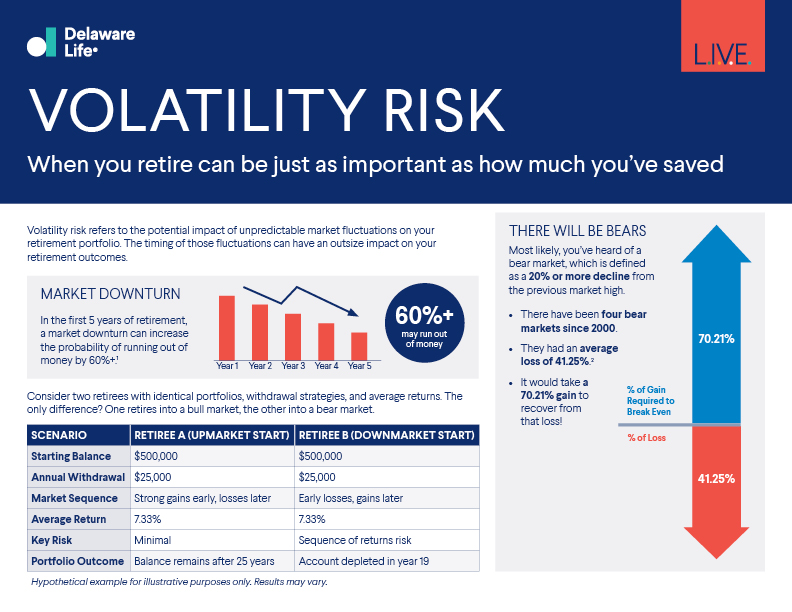
A market downturn in the first 5 years of retirement can increase the probability of running out of money by 60%.
Source: Morningstar Research
Market bumps can bruise your clients' retirement

Watch now: Why market volatility is uniquely dangerous in retirement.
Volatility risk refers to the potential impact of unpredictable market fluctuations on a client's retirement portfolio. Unlike inflation or longevity risk, which tend to follow longer-term trends, volatility can be sudden, emotional, and often amplified by media headlines. The risk is not just about what the markets do; it's about how clients react.
Volatility can erode client confidence, prompt impulsive decisions, and most importantly, undermine key pillars of retirement security: predictable income, long-term growth, and asset longevity.
As a financial advisor, your clients are looking to you to ease their fears and keep them on a steady path. We're here to support you with the tools and resources on this page.
A market downturn in the first 5 years of retirement can increase the probability of running out of money by 60%.
Source: Morningstar Research
The average loss during each of the four bear markets since 2000.
Source: J.P. Morgan Asset Management, On the Bench, 09.25

Get the details on the L.I.V.E. Retirement Risk Calculator – an interactive risk assessment that provides a visual roadmap to your clients’ greatest retirement threats.
Use this infographic with your clients to give them an easy, visual way to understand the impact volatility risk could have on their retirement.
Use this compound interest calculator to illustrate the impact of compound interest on the future value of an asset.